My dog doesn't need opening day circled on the calendar.
Somehow, she knows.
As summer starts giving way to fall, something changes. The mornings get a little cooler, the days get a little shorter, and she starts getting just a little more ramped up.
Suddenly, there's a lot more hunting going on in the backyard.
Hunting what, exactly? I'm not always sure.
Maybe there's something out there. Maybe there isn't. But she's working the yard like opening morning could break out at any second.
I think most people who hunt over a bird dog have seen it. They sense the change. They know when fall is getting close.
The problem is, being ready to hunt and being excited to hunt are two very different things.
After a summer of warmer weather, shorter workouts, and probably a little more time lying around the house than either of us would like to admit, opening day shouldn't be the first time we ask our dogs to really work.
Fortunately, getting a bird dog ready for fall doesn't have to mean some complicated six-week training program.
There are a handful of ridiculously simple things we can start doing now to help get them physically and mentally ready for the season ahead.
Here are five of them.
1. Start Taking Longer Walks
This one almost feels too easy to count.
Walk your dog.
That's it.
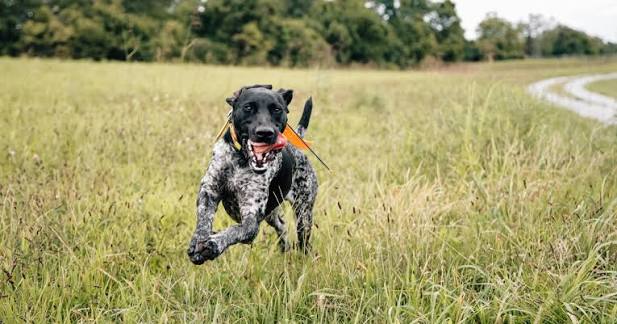
But think about what we're going to ask our dogs to do once the season starts. We're going to turn them loose in thick grass, cattails, brush, hills, and whatever else happens to be between us and the birds. They'll probably cover several times the distance we do while they're doing it.
And if we're being fair, a lot of our dogs haven't exactly been training like professional athletes during the off-season.
Mine certainly hasn't.
She's been active. She's been outside. She's done plenty of that questionable backyard hunting we already talked about. But there's a pretty big difference between cruising around the yard and spending a morning working cover.
So start walking.
Then walk a little farther.
As the weather cools and your dog gets into better condition, start mixing in longer walks, different terrain, some running, or whatever makes sense for you and your dog.
The important part is to build that endurance gradually.
You don't need to simulate a five-hour pheasant hunt right out of the gate. And trying to cram an entire off-season's worth of conditioning into the last couple of weekends before the opener probably isn't a great plan either.
Just get moving.
Opening morning shouldn't be the first hard workout of the year.
2. Make Them Think Again
There's a pretty good chance your dog remembers how to sit.
Probably.
But summer has a way of making everyone a little rusty.
Before the season starts, spend a few minutes here and there getting back to the basics. Sit. Stay. Come. Heel. Whatever commands you actually use with your dog in the field.
Then make it fun.
Throw a bumper around the yard. Hide it in some taller grass. Make them use their nose to find something instead of simply watching where it lands. If you've got access to training birds and know how to work with them, even better.
The point isn't to completely retrain your bird dog before fall.
You're knocking off the rust.
And this doesn't have to become another hour-long obligation added to your day. Ten minutes while you're outside after dinner is still training. A few retrieves before work is training. Making your dog wait instead of exploding through the door because you picked up a leash is training.
Those little repetitions start bringing back the habits you're going to want when there are actual birds involved.
Because it's considerably easier to remember that your dog has forgotten what "come" means while you're standing in the backyard than when they're 150 yards away and apparently negotiating the terms of their independence.
3. Pay a Little More Attention to the Food Bowl
I'm not going to tell you what you should feed your bird dog.
There are plenty of people far more qualified to have that conversation, and what works for my dog isn't necessarily what's right for yours.
What I will say is that as hunting season gets closer, I start paying a little more attention to what's going into the bowl—and to the dog standing over it.
As her activity starts increasing, I want to make sure she's getting what she needs to support it. I keep an eye on her body condition, how she's handling the extra exercise, and whether I need to make any adjustments as we start doing more.
That's really the point here.
We're asking more from our dogs as we get closer to hunting season. Longer walks. More training. More running. And eventually, long mornings working through cover.
Their nutrition needs to support that increased workload.
That doesn't mean you need to completely overhaul what you're feeding or start chasing whatever the latest miracle dog food happens to be.
Pay attention to your dog.
Keep them lean and in good condition. Feed a complete and balanced diet that works for them. And if you're not sure whether you should change how much—or what—you're feeding as activity increases, that's a great conversation to have with your veterinarian.
Because getting a bird dog ready for fall isn't just about putting miles on their legs.
You've got to put something in the tank, too.
4. Make the Vet Appointment Before You Need One
Nobody wants to discover something is wrong with their bird dog in the middle of hunting season.
Or worse, three miles from the truck.
That's why a preseason checkup is one of those boring little things that's worth getting out of the way before the season gets rolling.
I don't take my dog to the vet expecting them to find something wrong. That's not really the point.
I want another set of trained eyes on her before I start asking her to spend weekends running through grass, brush, cattails, mud, and everything else we somehow convince ourselves is fun.
A physical exam can catch things we might not notice ourselves—or things that are easy to shrug off when the dog otherwise seems perfectly fine.
It's also a good time to make sure the routine stuff is squared away and talk with your veterinarian about anything you've noticed while getting your dog back into hunting shape.
Maybe they're slowing down a little more than they used to.
Maybe they're carrying some extra weight.
Maybe there's a nagging limp that only shows up after a longer walk.
Or maybe everything looks great.
That's a pretty good answer too.
Because I'd much rather have my veterinarian tell me, "She looks good. Have a great season," than find out opening weekend that there was something I should've taken care of a month ago.
5. Sometimes the Best Training Day Is a Day Off
This might be the hardest one on the list.
Not for the dog.
For us.
Once the weather starts cooling down and hunting season gets close, it's really easy to get carried away. Longer walks turn into runs. Training sessions get longer. We're trying to squeeze everything we can into those last few weeks.
And if your bird dog is anything like mine, she's probably not going to be the one telling you to stop.
That's our job.
Rest and recovery are every bit as much a part of getting ready for hunting season as the work itself.
After a harder day, give them some time to recover. Keep an eye on hydration. Pay attention to how they're moving the next morning. If they look tired or sore, maybe today isn't the day to add another few miles.
Sometimes the right training plan is simply giving them the day off.
That's especially worth remembering once the season actually starts.
We've all been there.
The dog has already put in a few hours. You're tired. They're tired. You've made your way back toward the truck.
And then you look across the road.
There's one more field.
It looks really good.
Maybe just a quick pass...
That's usually when good judgment starts losing the argument.
Our dogs will hunt their hearts out for us. Sometimes it's up to us to decide they've done enough for today.
There will always be another field.
Get Ready Together
Maybe our dogs really do know when fall is coming.
Mine sure seems to.
She'll keep hunting whatever may—or may not—be living in the backyard while I start checking gear, watching the weather, and counting down the days until we're doing it for real again.
But getting ready for hunting season doesn't have to be complicated.
Walk a little farther. Knock the rust off. Pay attention to the food bowl. Make the vet appointment. And know when it's time for a day off.
That's it.
Five insanely easy things that can help make sure that when the tailgate finally drops this fall, we're both ready for what's on the other side of it.
Because as excited as I am for another hunting season, I already know who's going to be more excited.
She's been ready for weeks.